Romance of Alexander
* Introduction
This manuscript is about some adventures of Alexander the Great. These stories have been published in many languages and thus have been known in various regions of the world. The document that I present is of French origin with some English additions.
* Context (set the manuscript into its period and provide some background information)
The Romance of Alexander was written between 1338 and 1344, which was the period of the Late Middle Ages. The manuscript is in French verse and has miniatures and art in its margins. Two parts of the manuscript were added in England circa 1400.
The first production of the series of tales on Alexander the Great were made in the 3rd century. These first productions were in Greek.
* Author(s) or creator. What could you find out about them?
The artwork of the manuscript was done by the Flemish illuminator Jehan de Grise and his workshop.
The miniatures of "Li Livres du Graunt Caam" were done by Johannes and his school.
Wikipedia.org says that Callisthenes, Alexander's court historian, was believed to be the author of the series of books on the Romance of Alexander, but Callisthenes died before Alexander and could not have written a full account of his life. For now the author is still unknown and in general is called Pseudo-Callisthenes to imply that this author acted like court historian.
* Title(s)
The entire manuscript is called "The Romance of Alexander" and the additions have other titles. The English addition is called "Alexander and Dindimus" and is written in Middle English verse. Another addition is called "Li Livres du Graunt Caam" in French prose. There is also artwork in miniature form with each written work. The miniature of "Alexander and Dindimus" is coarser than the others.
* Links to photos of the manuscript
An artful page - http://image.ox.ac.uk/images/bodleian/ms.bodl.264/1r.jpg
Four vivid scenes - http://image.ox.ac.uk/show?collection=bodleian&manuscript=msbodl264
Funny art and story- http://image.ox.ac.uk/show?collection=bodleian&manuscript=msbodl264
Four vivid scenes - http://image.ox.ac.uk/show?collection=bodleian&manuscript=msbodl264
Funny art and story- http://image.ox.ac.uk/show?collection=bodleian&manuscript=msbodl264
A beautiful page - http://image.ox.ac.uk/show?collection=bodleian&manuscript=msbodl264
page directory - http://image.ox.ac.uk/show?collection=bodleian&manuscript=msbodl264
page directory - http://image.ox.ac.uk/show?collection=bodleian&manuscript=msbodl264
* Incipit
First line of the manuscript - http://image.ox.ac.uk/show?collection=bodleian&manuscript=msbodl264I can barely interpret the first line of the story. This is my deduction:
"Dieurs de riche eltoire [wants to understand and hear to take good example] to? prove? to welcome?"
I'm not sure of what the words with question marks are and I may have made mistakes in translation. The portion of the translation in brackets, I am most sure of. I'm not sure if the sentence goes on beyond 'welcome' or if it stops there.
* Explicit
The last words of the story - http://image.ox.ac.uk/show?collection=bodleian&manuscript=msbodl264
I cannot understand the last words of the story to translate them, but the word 'explicit' is at the bottom. I believe that Graunt's name is at the end as well. There is also a note to God: "Dieux ayie love?"
The mystery of it all is intriguing.
* Colophon
The colophon page - http://image.ox.ac.uk/show?collection=bodleian&manuscript=msbodl264
The script of the colophon is smaller and in quick-hand form as opposed to the more careful script style of most of the book.
 * Size
The manuscript is about 44 centimeters long and 30 centimeters wide. It appears relatively heavy and dense with 274 pages plus its covering.
* Binding
There is some thread at the top, which must be a part of the binding. The book's cover is composed of a back board. That makes sense that such a material was used to protect the the book's pages, which have such beautiful artwork.
* Material written on (parchment or paper)
The manuscript is printed on parchment.
* Collation and how was it put together: rulings & page
Rulings -
The manuscript is ruled. According to "Understanding Illuminated Manuscripts", because of the date of creation of this version of the Romance of Alexander, the ruling should have been done with ink having been made in the 14th century.
Page -
The pages are well cut rectangles. They are surprisingly clear despite the age of the manuscript.
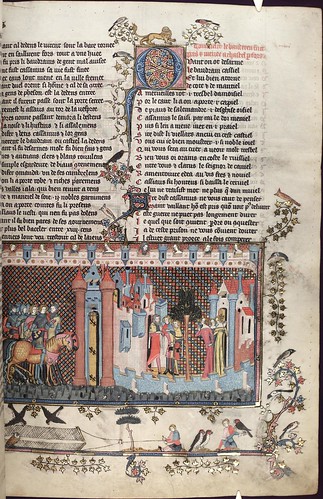
The text is divided into two columns. There is more empty space at the bottom of the text blocks than above the text blocks. The artwork displaces the text on some pages or in the case of the drawings of plants, weaves along the text similar to a border.
* Script(s) or type of writing
The script is the classic gothic of the medieval period.
* Hands of different scribes?
The colophon seems to be in the hand of a different scribe or perhaps simply written in normal handwriting. This is because the writing of the colophon is less clear and smaller than the writing of the main text.
* Ink
Most of the ink is dark, probably intentionally black, but over time it has faded to a dark brown. Some sections of the script are in red ink and some uppercase letters like those in the incipit page have a dash of red ink.
* Rubrication
There are slight red strokes through the first letters of each line on some pages. Those pages mostly feature text. It is a pretty detail whose function is to guide the eye of the reader.
* Decoration
Some of the more simple forms of art in the manuscript are flower-like or vine-like, whimsical drawings on various pages.
* Illumination/Painting
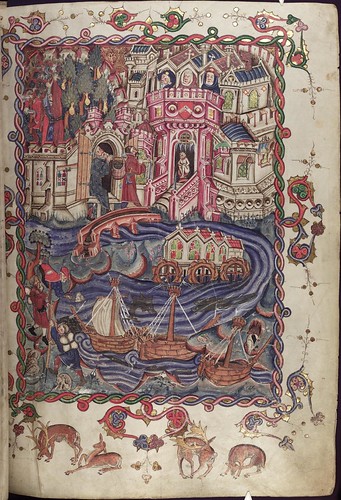
The manuscript has plenty of artwork. Some of the art is humorous and many scenes of art depict interesting situations. I think that gold leaf may be in some scenes of art where there is a bright yellow color.
* Summary
The Romance of Alexander is a beautiful relic of the 14th century. The manuscript is extremely well crafted and is a beautiful work of medieval publishing. It seems unfortunate that the precise author of the story is not known, but this adds to the enchantment of the manuscript. I imagine that many people of medieval times have gathered together to hear the legends of Alexander the Great told before a hearth (fireplace). Perhaps there were public readings of the stories and perhaps they were used to perform plays for various classes of people.
What is interesting is that the manuscript is so well decorated that it's possible that many illiterate people listened to the story told and looked at the pictures to understand what they heard. The design of the manuscript is even echoed in picture books and story books for children of today. It is pertinent to say that such an old manuscript still has an influence on today's world for most people remember Alexander the Great and can appreciate the artwork of the manuscript even if they can't read the story.
* Reference Page(s)
Alexander romance. (2011). In Encyclopædia Britannica. Retrieved from http://www.britannica.com/EBchecked/topic/14218/Alexander-romance
Alexander romance. (2011). In Wikipedia. Retrieved from http://image.ox.ac.uk/show?collection=bodleian&manuscript=msbodl264
Bodleian Library. (2011). The romance of alexander. In Early Manuscripts at Oxford University. Retrieved from http://image.ox.ac.uk/show?collection=bodleian&manuscript=msbodl264

